
Thank you for Subscribing to Construction Business Review Weekly Brief


A commercial building owner recently faced a familiar dilemma—four contractors, four identical diagnoses and four proposals recommending a full tear off and tapered insulation system. The combined price approached half a million dollars. Before committing, the owner contacted Flat Roof Solutions (FRS). Rather than pricing the same scope, the team questioned it.
During the site evaluation, FRS found the membrane was still performing. The problem was with the drains. Set too high above the roof surface, they held water instead of releasing it. Lowering them restored drainage, eliminated ponding and preserved the existing system. The correction cost roughly $50,000, saving the owner the remaining $450,000.
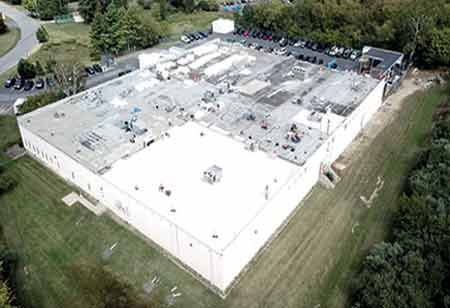 “We try to give people options and let them decide what fits with their business,” says Jared Van Vranken, vice president. “Every recommendation starts with the building’s condition and the owner’s long term plans.”
That discipline has defined FRS since founder Bert Pearson established it in Malvern, Pennsylvania, in 1997. Pearson brought over three decades of experience in industrial coatings, including work on nuclear facilities and oil tanks, where misdiagnosing a failure point can have severe consequences. The same engineering rigor now guides every FRS project: understand the system, identify the cause and recommend only the work the building requires. Today, the company serves property owners across the Mid Atlantic, with over two million square feet completed across EPDM, TPO, PVC, metal, asphalt and foam systems.
Planning Before the Crisis
Commercial roofs typically reach replacement only once every two decades. Because the interval is so long, most owners arrive at the decision point without a budget, timeline or framework, precisely when rushed choices become expensive ones. FRS changes that pattern through annual and semiannual inspections that map membrane condition, remaining service life and the cost of the next stage. Owners who understand what is coming can plan for it; those who don’t are forced to react.
When inspections reveal a membrane that is aging but still structurally sound, a coating system can extend its service life at roughly half the cost of replacement. Silicone, acrylic and urethane coatings restore waterproofing, reduce heat absorption and lower energy use without the waste and disruption of a tear off. Qualifying projects may be deductible under Section 179 of the tax code, subject to confirmation by a tax professional.
Routine inspections extend this diagnostic approach across the full exterior. The team documents membrane wear, third party damage and debris obstructing roof drains. When deficiencies exist, owners receive an estimate. When the roof is performing, that is documented as well, giving owners an accurate baseline rather than an unnecessary expense.
Finding What Others Miss
Most client relationships begin with a service call. What distinguishes FRS is what happens before the repair. Rather than addressing the visible symptom and billing for the visit, the team traces the problem back to its source. A leak near an HVAC unit, for example, may originate from deteriorated siding on an adjacent wall rather than the membrane itself. Where the source lies within the roofing system, FRS carries out a permanent repair. Where it originates elsewhere, clients receive a clear written account of what the inspection found. Identifying the true failure point ensures the repair holds. Missing it guarantees the problem returns.
-
We try to give people options and let them decide what fits with their business. Every recommendation starts with the building’s condition and the owner’s long term plans.
Routine inspections extend this diagnostic approach across the full exterior. The team documents membrane wear, third party damage and debris obstructing roof drains. When deficiencies exist, owners receive an estimate. When the roof is performing, that is documented as well, giving owners an accurate baseline rather than an unnecessary expense.
Built to Last
Quality control is embedded in the installation process. Foreman Mark, who has spent nearly two decades with FRS, ensures every system meets manufacturer specifications before the independent inspector arrives. Because the work is correct before it is reviewed, the No Dollar Limit warranty is issued without conditions.
Safety coordinator Frank conducts a Job Site Analysis before each project, identifying hazards and defining controls so that a clean safety record is the result of the process, not chance. Upon completion, FRS provides complimentary spring and fall inspections during the first year to confirm the roof continues to perform as it did at handover.
“The roofs don’t leak when we’re done,” says Van Vranken. FRS is now expanding geographically to support clients with properties across a wider region and pursuing federal and public works contracts, extending the same diagnostic discipline into new markets.
A Better Basis for Flat Roof Decisions
A leaking flat roof rarely shows up as a clean procurement decision. Water travels, so where it appears inside the building usually has nothing to do with where it’s getting in. Old patches hide earlier failures. Rooftop equipment blocks access. Maintenance records, if they exist at all, often raise more questions than they answer. The instinct is to patch and move on, but patching without finding the source just delays the same problem and adds cost to it.
Budget timing makes things harder. Roofs stay off the radar for years, then suddenly need serious money. Buildings that changed hands midlife are especially tricky — prior work may be incomplete, undocumented, or not up to current standards. Owners who inspect regularly have a real advantage. They know what the membrane looks like, where drainage is struggling and roughly when replacement becomes unavoidable. That kind of visibility lets capital get planned rather than scrambled.
Full replacement isn’t always what the roof needs. Wet insulation and widespread membrane failure usually push in that direction, but plenty of roofs can be repaired, coated, or partially replaced instead. The contractor has to make an honest call there and the proposal should spell it out — what’s still working, what isn’t, how long each option realistically holds up. A cheap number that just delays the inevitable isn’t actually cheap.
Older buildings need extra attention to scope. The membrane often gets blamed when water is actually coming in around a parapet, a penetration, or a drain detail. A proper assessment rules those out before anyone commits to a replacement. It should also separate the urgent work from the stuff that can wait, so bids can actually be compared. A lower bid that leaves out deferred work isn’t lower — it just hides the rest in future change orders.
How the work gets managed matters too. Crews are working above occupied space, around HVAC units, near edges. That’s not a situation where supervision can be loose or personnel inexperienced. Buyers should ask direct questions about how the site is run, not accept vague safety language.
Once the work is done, accountability shouldn’t disappear. Manufacturer registration, inspection during installation and a no-dollar-limit warranty give an owner real recourse if something goes wrong. Ongoing inspections catch the small stuff — debris blocking drains, minor damage from service traffic — before it turns into a bigger repair.
Flat Roof Solutions works well for owners trying to make this decision clearly. It does the leak tracing, the building-exterior assessment, the scheduled inspections and then lays out options honestly — repair, restoration, coating, or full replacement, depending on what the roof actually needs. Installed systems can carry manufacturer-backed no-dollar-limit warranties with manufacturer inspection built into the process. In-house crews and job-site safety planning add oversight during the work itself. The goal is a decision built on real conditions, not a default assumption that replacement is always the answer.
...Read more
